“Is there hope for the future?”: a Forecast for the South Wales Valleys
Updated: Mar 6
This urban project employs various techniques to predict a wide range of potential future urban environments. It includes extrapolations from historical trends and the expected impact of emerging technologies. Another technique used is the Literary Method of Urban Design, which leverages literary works to forecast possible future urban scenarios. This blog post focuses on one urbanized region in Wales that has been recently analyzed using this method.
Introduction
Anxious policymakers across the world’s cities are often in search of methods that will enable them to foretell oncoming socio-political, technological or environmental changes and challenges that lay ahead, near or far (see: Miedzinski, Sniazhko & Muralidharan, 2019). According to recent published research (such as Marshall, 2019, and Marshall, 2023) there is a way to predict the general socio-environmental futures of cities beyond the realms of probabilistic analysis of current trends; one that uses literary histories to decipher the lives of urbanized human beings in their cities as they endeavor to explore both mindless and mindful characters as reflective social agents positioned in a certain setting. This approach specifically uses the literary heritage of those cities and the method it is distilled into is called the Literary Method of Urban Design and it offers a unique approach of via works fiction to anticipate potential scenarios in urban design. The Literary Method emphasizes the potential social utility of literary art in urban studies and explores the complexities and possibilities of our evolving urban existence. In short, it is a highly creative way to think about how we can shape our cities in the future.
According to Marshall (2018) and Marshall (2023) the Literary Method involves the following three main steps:
1. Select a work of literature: Choose a piece of literature that offers insightful themes or narratives about human society, culture, or behavior.
2. Select a city: Choose a city that you wish to design or redesign. This should be an existing city or a 'revamped' and / or 'disrupted' version of a present city.
3. Apply the themes: Use the themes or narratives from the selected work of literature to envision the future of the selected city. This could involve designing infrastructure, public spaces, or even social policies that reflect the themes of the literature.
Often the futures of cities around the world are determined ad hoc year on year by commercial trends and civic matters (Konvitz, 2016) with more distant plans for further ahead laid out by government technocrats (Kelly, 2010; Denhem-Holm, 2014). The latter will try to formulate a good urban plan that balances economics with social issues and projected finances. However, to do so, the planners need some way to forecast the future and this is usually done by assembling data about changing commercial, transportation, and demographic trends and long- term projected revenues and expenditures (Bruggman, 2009). However, I’d like to suggest that the future can be approached via the arts through the literary method in way that is useful, and engaging, for both planners, and especially students studying the future.
According to Marshall (2023) there is a way to predict the general socio-environmental futures of cities using literary approaches beyond the realms of data. This approach specifically utilizes the literary heritage of those cities. However, since this particular work was published in the Utopian Studies journal we might have to be aware that it either is a reflection of Utopian humanities scholarship, and thus empathetic of the Utopian impulse, or, indeed, an actual prognostication of “Utopian” urban design. (For explorations about the long-acknowledged problems of deriving social policy from Utopian analysis, see, for example, Davies, 2023).
In any case, the suggestion is that the futures of specific urban settings can in some way be predicted by referring to literary works which locate their stories in those same urban settings. The reason why this is possible is that deep literary investigations of places reflect on the characters to that place. If the place is a city, then the literary work will offer patterns of reflection and experience which determine the forces in that city, and then, if extrapolated into the future, they offer a glimpse of things to come.
As noted above -- in Marshall (2018) and in Marshall (2019) -- the first of the three stated steps of the process of the Literary Method is to pick a work of literature. For this particular case study, I’ve selected the a literary work titled “The Bells of Rhymney”, a 1930s poem written in English by the Welsh poet Idris Davies. For step two, the eight towns mentioned in the poem are selected. In anticipation of the third step, the following section outlines the major themes of the selected poem. After this, the subsequent sections will then be applying these themes to the chosen cities.
The Themes of The Bells of Rhymney
The Bells of Rhymney is a poem written by Welsh poet Idris Davies in 1938 and published in a collated book of Davies’ poems called Gwalia Deserta (Davies, 1938). The poem reflects the economic struggles of various deprived and exploited coal-mining towns in the Valleys of South Wales during the interwar period. At this time, the Great Depression had just recently washed over the global marketplace and over Wales, too.
O what can you give me?
Say the sad bells of Rhymney.
Is there hope for the future?
Cry the brown bells of Merthyr.
Who made the mineowner?
Say the black bells of Rhondda.
And who robbed the miner?
Cry the grim bells of Blaina.
They will plunder willy-nilly,
Say the bells of Caerphilly.
They have fangs, they have teeth
Shout the loud bells of Neath.
Even God is uneasy,
Say the moist bells of Swansea.
Put the vandals in court
Cry the bells of Newport.
O what can you give me?
Say the sad bells of Rhymney.
In the 1960s, the poem became very famous serving as lyrics to a hit song of the same name by the American rock group The Byrds (see audio / video below).
Those that hear the song version for the first time often believe it to be story of one or other Welsh mining disasters. Indeed such disasters were quite a regular occurrence in south Wales and two particular disasters probably affected much of the tone of Davies’ desperate poem; that is the 1913 Senghenydd colliery disaster near Caerphilly and the Marine Colliery disaster of 1927 in Monmouthshire -- when 52 miners dies in an underground explosion (see Graham-Jones, 2014, for an outline of these disasters).
Although other written works by Davies show these disasters affected him to the heart (see Paul, 2009), it is far more the general social and economic background of the South Wales mining community that he was writing about in The Bells of Rhymney. In this poem, Davies seems to highlight the social betrayals suffered by the people of South Wales and also the dashing of their hopes and dreams for a better future.
As a son of the Valleys himself, Davies describes from the inside – and with great effect -- the troubled psyche of toiling miners whose lives were entrenched in the unforgiving coal pits. Their struggles, hopes, and perhaps also the rhythmic symphony of their labor became the raw materials for Davies'; lyrical laments in The Bells of Rhymney (Roberts, ed, 2003). Thusly, lines of The Bells of Rhymney reflect their working conditions, their everyday despondency, and the entrenched economic hardships faced by mining communities in general.
At the time, the South Wales Valleys were generally regarded as a ‘hot bed of radicalism’, generally of the socialistic kind. The miners’ radicalism was largely founded on the appalling conditions they had to work and live in and their observance of how Britain was then dominated by age-old traditional classes whose elite members had were unsympathetic to laborers and workers. These conditions and disparities resulted in the miners going on strike to demand no more reductions be taken from their dwindling pay and no more eroding of their work rights. In 1926, these coalminer protests transformed into a national general strike as over one million workers from all industrial sectors of society came out in sympathy for the coalminers. Alas, the general strike crumbled into defeat.
Ultimately, the strike ended without the miners' demands being met, and many miners returned to work under less favorable conditions than before. The failure of the strike had long- term consequences for the coal mining industry in South Wales, as it weakened the position of trade unions and led to further decline in the industry in the subsequent decades (Sewall and Dear, 2020). The poem can also be interpreted as a reflection of the way private enterprise and government combined to side against them as well, suggests Wynn-Thomas (2021).
The defeat of the strikers had a profound effect on both the economy and society of South Wales Valleys (Selway, 2016). The coal mining industry was already in a state of depression, and after the strike failed, the miners were having their pays cut -- whilst some workers were laid off entirely. All this put the entire South Wales region under stress. On top of this, the health and safety programs were often lax, meaning miners were subjected to risky and dangerous work just as ever – yet paid less for it (Wynne-Thomas, 2021). The poem thusly evokes a rising anxiety about safety endured by miner’s families and the wider community, all the members of which were aware that the social, financial and managerial backstops for mineworker welfare were being withered away to help mine-owners save their employers businesses and earn investors higher profits.
If that is the social background of Davies’ Wales, you might also let me explain the artistic symbols involved. The title refers to the bells of the town of Rhymney, Davies’ own hometown. The bells symbolize the passage of time and the cyclical nature of life. The ringing of the bells serves as a reminder of the passing hours – sometimes fraught with anxious worry about the end of the working day perhaps -- but it also carries a deeper symbolic meaning; possibly representing both hope and despair at the same time or differentially (Vaughn Jones, 2010; Wynne-Thomas, 2021).
The bells also convey or embody the relentless passage of time, tolling not only for the hours worked in the subterranean realms but also for the broader year-on-year struggles of the Valley’s working class. As the bells ring, they carry the weight of the long 19th century change that was the industrial revolution (Janes, 2023) plus the clangor of technological progress – or destruction -- that transformed the landscape of the Valleys and the lives of its people.
Thusly, the bell’s clangs and clamors not only mark the passage of time but also bear witness to the social upheaval. Davies, with a poet's sensitivity, captures the struggles of the working class, their hopes and dreams interwoven with the metallic echoes of the bells (Vaughn Jones, 2010; Wynne-Thomas, 2021). It is a symphony of life, in a way, a composition that encompasses both the mundane and the profound.
The poem also explores themes of loss, both of livelihoods and of a way of life, as well as the resilience of the human spirit in the face of adversity. Davies employs vivid imagery to evoke the harsh realities of coal mining life. He intimates the physical toll on the miners, the bleak landscape, and the emotional burden carried by the women and children in mineworker’s families. The tone of the poem is sympathetic and mournful, says Jenkins (1986), expressing solidarity with those who descend the pits and acknowledging the sacrifices they make for their families.
Envisioning the Future: the Towns of the South Wales Valleys
As well as applying the general theme of the poem to the social setting of the South Wales towns and cities -- to see how they may develop -- here below I also aim to read out the individual poetical line references that the poem confers upon each town contained within it. This is quite a simple process in this specific case study of the Literary Method of Urban Design, since each of the towns mentioned in the poem has a short sentence for us to engage with. In light of this, each section is headed by the associated semi-line from the poem.
1. "What can you give me?" -- The Future of Rhymney
This first line of the poem references the town of Rhymney and asks “What can you Give me”. This certainly starts the poem off as a somber dirge. From this line, the bells themselves are so despondent that they begin not via a word but through a plaintiff cry. It is significant that the song version of the poem, written by Pete Seegar, brings this sentiment to the fore by delivering the first line in descending manner -- as though it is a misplaced closing line of a song. If interpreted in this dark pessimistic, somewhat terminal, manner then this first line foretells a of hopeless yearning, suggesting that the speaker of the line is seeking something more than material gain but cannot really muster up enough hope to crawl out of a setting of crushing loss and discontent. (Only by the poem’s end will we recognize this first line might also be a plea for a fair and meaningful existence amid the struggles of an unsure, technologically gruesome, and unfair world).
Although the first line seems stark in its pessimism, and especially so in a jangly 1960s pop song – and even for a serious folk song -- we surely must acknowledge audience interpretations can be highly peculiar and subjective, to the point where readers could feel this opening line is actually an emotional and somewhat hopeful plea for resolution, restitution, and some kind of restorative justice. Thusly, “Oh- what Can you give me…” might not be thought of as a completely closed and forlorn cry at all, but an open-ended quest for justice.
As foretold in the introduction, Rhymney nowadays is a typical postindustrial town. Before the rise of the coal industry, and prior to that the rise of copper and iron sectors there, both Rhymney and most of the South Wales Valleys were purely non-urban and agrarian. The town only came into being as a solid urban setting during the mature part of the industrial revolution and was a major player in the South Wales coal business. That was until changing global commercial circumstances -- and stiff international competition -- forced the mines nearby the town to shut. These closures proceeded slowly at first throughout the 20 th century and then all of a sudden in the Thatcherite years during the 1980s. As the whole industry collapsed, the British conservatives – usually defenders of British industrial might -- refused to prop it up and save it. (Indeed, Sewall and Dear, 2020, suggest, the Conservative Party probably wanted the industry to decay just to rid the UK of the powerful unions associated with the mining sector).
Since the 1980s, there have been repeated attempts to regenerate and rejuvenate the economy of the South Wales Valleys, mostly aimed at attracting inward business investments. Another avenue for recovery -- and one sometimes encouraging a smidgen of economic success -- has been to celebrate the South Wales Valleys towns as sites of past industrial glory which has sometimes raised community self-esteem and attracted day-trippers and tourists (Price, 2020).
As an example of the latter, a grand piece of red-brick art was commissioned by the local authorities of the Rhymney Valley from artist Brian Tolle in 2011 and now sits in archway form as a heritage-affirming sculpture on a nearby ridge (BBC South Wales, 2010). The sculpture has been titled Twisted Chimney and it strongly suggests that the Rhymney Valley’s industrial heritage and the town’s post-industrial life can be combined functionally to heal various problems; be they social, psychological, or environmental. Whilst the arching Twisted Chimney sculpture is a Valley favorite, it was rather expensive to build and offers not much of anything practical for the Rhymney Valley since it’s just a piece of non-working art. Perhaps it might attract a few day trippers from England to visit but its main purpose seems to be to raise the
spirit of locals by helping them to celebrate their heritage.
Given all this background, and Rhymney Valley’s history, and most significantly given the Davies’ opening line in the Bells of Rhymney and the 2011 sculpture built overlooking the Rhymney Valley, I now present a scenario of Rhymney’s late 21st century future below.
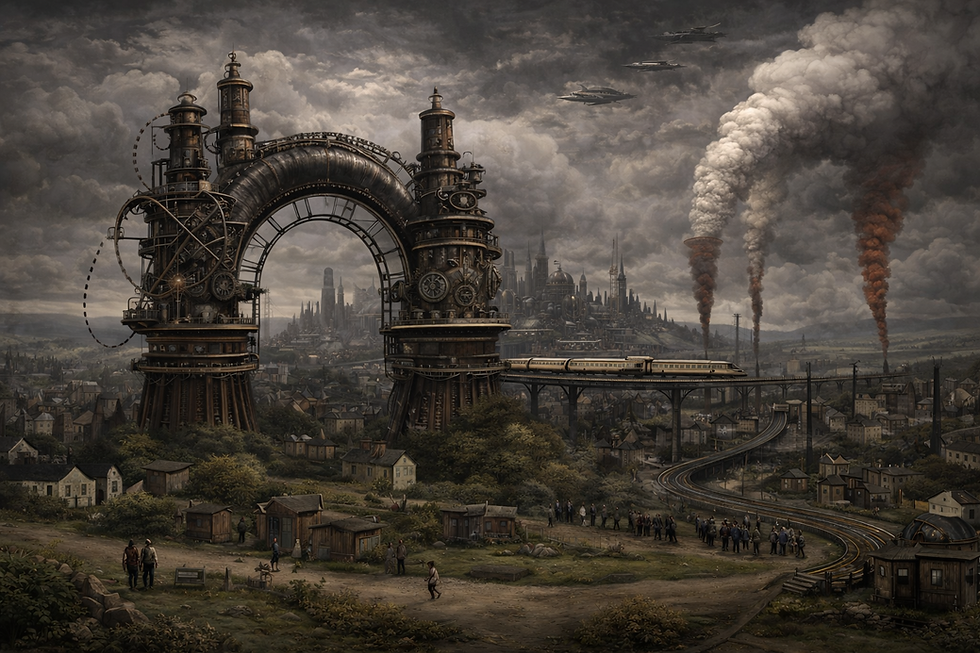
In the scenario envisaged here, a new working carbon-capture factory is built on another ridge overlooking Rhymney -- and in a similar retro-industrial style and archway form like the original 2011 sculpture. Unlike the Twisting Chimney sculpture, this new sculpted facility is not merely an aesthetic object but a working factory, sucking carbon dioxide from the air and plunging it deep beneath the Welsh hills.
However, like the sculpture, it really acts like a symbol that conveys they idea that it was industrialism that created the South Wales Valleys, and, more significantly for us, that industrialism can yet provide for a sustainable future by neutralizing the carbon dioxide of the industrial world – both that made in yesteryear and in the 21 st century. Those that build the facility say they’re creating a factory that reverses the damages and dangers of the Industrial Revolution (in the line of modern decarbonizing technopreneurs outlined by MIT writers like Herzog (2018), and that it can also prompt economic development of South Wales in the process (echoing the likes of writers like Lenox (2018).
However, just since carbon capture technology suffers numerous problems, such as the following: Profound Technological Challenges: Carbon sequestration technologies are still in relatively early stages of development and deployment. The most common method, geological storage, involves injecting captured carbon dioxide into underground formations. However, this process has many drawbacks. It requires hard-to-find suitable geological formations, for instance. And can be exceedingly expensive.
Also, while carbon sequestration has the potential to temporarily mitigate carbon dioxide emissions, there are concerns about its long-term viability and associated risks. For example, stored CO2 could potentially leak back into the atmosphere over time, negating the benefits of sequestration. There are also risks associated with geological storage, such as the potential for earthquakes or groundwater contamination. Furthermore, carbon sequestration may divert attention and resources away from more sustainable solutions, such as renewable energy and energy efficiency measures, which address the root causes of carbon emissions.
If these problems and dangers are so significant then in this case, when The Bells of Rhymney asks “O What Can You Give Me”, modern day industrialists are offering dubious promises of redemption and prosperity based upon more risky technology and engineering solutions that probably will not even work, let alone spur economic success in the region. In the spirit by which Idris Davies offered up his poem, The Bells of Rhymney might rightly cry out once again (as we see in final section of this article).
2. "Is there hope for the future?" -- The Future Merthyr
If the first line is the bells sound nothing much more than a somber dirge, the second line might just possibly express a small seed of hope as it asks whether the church bells of Merthyr Tydfil might “hope for the future”. When an individual or group of individuals are led to contemplate any kind of future for themselves, there is always a chance (though one knows not how great) that things will get better. In this regard, Maybe Davies’ poem imagines the 1930s Welsh economy might improve all by itself as time passes. Or maybe it imagines British politics will take a democratic turn, thus offering more power to the working classes than so far gained. Or if the exogenous forces do not improve, perhaps the people of the Valleys can work together within their community independently of the wider British capitalist economy and national political system to become secure themselves as stewards of their own local or regional future (as commented upon by the likes of Ballard, 2004 and Ward, 2015). This can be achieved despite the cycle of exploitation and abandonment that has plagued South Wales valleys for a hundred years (again as commented by the likes of Ballard 2004 and Ward, 2015).
The scenario painted here below accepts the possibility that the future of the town Merthyr Tydfil might -- by shear stint of lucky unforeseen circumstances -- head upwards rather than downwards.

Davies himself had a strong connection with the countryside around Merthyr Tydfil. Although he knew it to be despoiled and polluted by the mining industry, with dangerous and toxic slag heaps scattered about just outside the town, Davies could still find within the area, semi-wild serene places that he might explore to reinvigorate his weary industrialized mind. For instance in another poem he says this about the moorlands surrounding Merthyr Tydfil:
Scatter my dust on the moorland
Where I dreamed my boyhood’s dreams,
Where the reeds are, and the curlews,
And the quiet springs and streams.
This is the landscape to which Davies escaped for adventure and solace as a youngster and where his boy hood dreams would be formed and fashioned. And as Davies noted elsewhere in work noted above, such “boyhood dreams only die when you do”. Indeed, Davies also opined the not uncommon refrain that as one grows older, we often hark to the past as we hope for the future (Alokovska, 2018; Sharma, 2021).
Given this, and the openness of any future, the above printed scenario forecasts a green and pleasant Merthyr Tydfil where the Glamorganshire canals are regenerated as artificial rivers (in a vein predicted elsewhere in the world by Havolk et al, 2014) whilst the damaged hill slopes are reconstituted into urban forests and the hilltops revegetated with vibrant moorland grasses. The specter of a postindustrial wasteland is replaced by one where the beauty, splendor and services that natural ecosystems might provide are at once practical, aesthetic and spiritual. Instead of the gigantic machine depicted in the previous scenario, in this one, there are trees and grasslands acting as to capture carbon naturally -- and to store it in sustainable manner.
However, as the illustration above shows, just as Merthyr Tydfil starts forging a future that recuperates the natural environment, the global warming erupts with wildfires to indicate that even if the future is rosy, it is still replete with challenges.
3. “Who Made the Mineowner?" -- The Future of Rhondda.
If the first line cries hopelessness yet the second evokes some kind of hope by pondering the possibility of a better future, the third line takes a tentative step into the political realm. If we admit that some form of corrective solution can only be applied if we can identify the source of the problem, then this might be what’s happening within this line -- and within the graphic scenario presented below.

The “Who made the mine-owners?” line alludes to the idea that mine companies grew their wealth on the backs of the miners. The future envisaged here acknowledges this situation -- and tolerates it somewhat -- but it also displays a future wherein there is a strong obligation -- written into law and ethical codes -- for mining capitalists, plus their investors and industrial managers – to ‘pay back’ the miners’ communities by stimulating and promoting the towns and cities -- where they are all entangled together -- in order to improve general human welfare and provide for vibrant civic cultures.
Such an agreement harkens back to the corporatist social contracts of the mid twentieth century (Booth, 2001), where various socio--economic classes attempted to cooperate for a consensually arranged and shared future. As the graphic alludes, in the towns of the future Rhondda Valley, labor unions push to allow economic benefits to flow to their members but they do so without threatening either the managerial and upper classes. In turn, the riches made by the mining companies percolates either via tax or by voluntary contributions into the infrastructure of the Rhondda, as well as into its public architecture.
This architectural reinvestment – legally-mandated or not -- tends to serve and satisfy all community members, even if there’s a gigantic gulf in personal incomes between rich capitalists and everyday workers. By promoting a splendid civic environ, protestations and advancing radicalism in the Rhondda Valley is fended off with beautiful public schools and libraries, concert halls, health clinics, civic meeting rooms, and all-access pedestrian walkways, so that the community can at least feel more livable and the people cared for in some manner (at least in comparison to the late 20th and early 21st centuries – see Rees and Rees, 1980, and Thompson et al, 2012) .
4. “And Who Robbed the Miner?" -- The Future of Blaina.
As the poem unfolds into the fourth line, those that are suffering under an exploitative working setting declare it openly; the miners are being “robbed”! Sitting line outlined previously, we see the poem move from seeking empathy and humanity to becoming a clarion call for rebelling against the biased policies of the mine-owners and their friends in government. According to this line, the miners of the South Wales Valleys, including the small town of Blaina, have been robbed of their dignity, their safety, as well as any fair treatment and future economic welfare. Thusly, the fourth line comes as a cry for resisting those perpetuating social and economic injustice.
In the scenario pictured below, this call for justice has been – over a lengthy period of time, decades maybe – more or less heeded and achieved.

Currently, Blaina has a beautiful, rehabilitated lake in the northernmost reaches of the town located just under the Cwmcylyn mountain reserve. In a way, it can be held out as a successful example of ongoing environmental restoration in the South Wales Valleys since the once polluted waterway has gradually been returned to pre-industrialized tranquil beauty. Compared to decades past, the decades of the future will see slowly developing within the lake a healthier arrangement of non-dangerous waterborne lifeforms – including fish and freshwater crustaceans -- that is fast attracting greater and greater hordes of tourists and weekenders, especially foodies, nature-lovers and anglers.
However, because it is becoming so beautiful, the lakefront zone has also become prime real estate for the private housing market and the reserve is set to become much more limited in access; with new luxury homes and apartments restricting public ingress to lakeshore and associated wetlands.
This growing exclusivity does not go unnoticed by the rest of Blaina’s residents and, eventually, they collect together to publicly insist on their right to partake in the beauty of the lake by composing community-wide public access by-laws. These act to robustly preserve public walkways, cycleways, boat ramps and boardwalks to and from – and around -- the lake. The town of Blaina then works with various social clubs and civic groups to assert common ownership over the lake and its surrounds, to foster its burgeoning natural beauty, and also to creatively integrate the industrial heritage of the reserve. In this way, an old canal boat becomes a floating organic produce cafe, and chiming vibrational wind turbines -- shaped like
pithead support towers of yesteryear -- are erected and re-erected to give future Blaina its own
distinctive suburban landscape.
5 “They Will Plunder Willy-nilly" -- The Future of Caerphilly
Halfway through the poem -- and just as we might hope for some workable compromise between the capitalist class and the working class as the towns of South Wales Valleys forge their own future -- a series disastrous climate change events will likely wreak havoc upon the Welsh landscape. This graphic scenario below, for instance, shows the town of Caerphilly in flood after a series of record-breaking rainstorms.

Far from being an isolated event though, as the 21st century proceeds and climate change in Britain becomes more pronounced, such floods become more and more common (see Davies, 2020). Floods like these not only drown riverside towns in stagnant water, they convey great pollution through the streets and cause landslides large and small. Since, some of these landslides unearth unremediated industrial waste from decades past (as explained by Cassale and Margottini, 1999) as well as more recent agricultural waste. All this flooding and associated pollution destroys or degrades infrastructure, from roads and bridges to sewage systems and public buildings. Indeed, such watery degradation will probably ruin the old stone facades of many well-loved works of South Wales architecture, covering them in slimy dirty filth – and eroding them away little by little as well. Thus, climate change challenges the architectural heritage of Caerphilly which -- building by building – gradually crumbles.
Some waterways are so engulfed and swollen by continuing rainstorms that South Wales Valleys might be subject to perma-flood conditions – and revert to being wetlands. Of course, although climate change is every body’s concern, those capitalist enterprises who gain profits by producing and selling climate-changing products, especially coal and steel, will be the ones to drag their feet as a transition to a fully sustainable economy is tabled by political leaders then recognized as important by the people (as explored by Klein, 2015).
Thusly, this fifth line of Davies’ poem (“They will plunder willy-nilly”) warns that the gross industrial exploitation of the Valleys is far from a thing of the past but may continue in the future.
6. “They Have Fangs, They Have Teeth" -- The Future of Neath
Whilst some single environmentally-challenging businesses admit to and apologize for their adverse ecological impact – and even promise to change their ways toward a more sustainable form – there are those who will probably long continue to deny climate change or even suggest that it is not such a bad thing anyhow (as promoted by the likes of Rathi, 2024). Such industrialists will fight back against eco-consciousness of both governments and the public to derail restrictions as best they can (as explained by Gouldson and Murphy, 1998) including via public statements and straight-out propaganda saying that the global economy must on no account be hurt just to stop dubious adverse climate change impacts.
If the coming future decades, Britain falls under such a regime of organized and well-funded resistance to eco-friendliness -- and with some fossil fuel friendly governments back in power -- then environmentally-degrading industries (from coalmining to gas fracking to ironmaking and copper-making) might well find themselves getting huge subsidies and supportive legal frameworks. This might especially apply to South Wales -- if it does not manage to expunge itself from the United Kingdom by the later decades of the 21st century.
Of course, because such enterprises can perhaps only maintain their profitability by being regulated by very soft environmental standards -- and chronically bad labour conditions -- then when new iron foundries and coal mines are opened-up later this century in the South Wales Valleys, a new program of environmental degradation and worker exploitation will arise. South Welsh towns like Neath, who had spent decades rehabilitating polluted streams and slag heaps, now become degraded once again.
One of the ways that governments, conservative figures, and corporations can begin this grand re-infliction of past deeds onto future Welsh communities is by promising money for traditional Welsh cultural ventures, including Rugby Clubs and heritage sites like Neath abbey.

Though one of these is derived from English culture and the other was wrecked by an English monarch (when King Henry VIII dissolved all the nation’s monasteries in in the 1530s) they are both regarded as quintessentially part of the South Wales landscape, Because the new copper makers and coal miner operators promise to support both rugby and the Neath Abbey, they are forgiven for their deadly social and environmental sins. Anyone that disparages such investment in popular Welsh culture is then suspected of being unpatriotic and criticized for being anti-Welsh.
7. “Even God is Uneasy" -- The Future of Swansea.
If there is a resurgence in industrialism -- and grand-scale technological projects in the vein of some of those depicted above -- then renewed iron smelting and coal mining might encourage a grand rise in financial investment into the South Wales Valleys. Probably, in this case, the British government will also forge ahead with a variety of new grand infrastructure projects in late 21 st century Wales. One of these is a grand new lagoon-like harbor port for Swansea, as depicted below (and which serves as an enlarged Vision of present proposals for an artificial lagoon near the city, see BBC, 2018).

However, as the line “Even God is Uneasy” attests, such huge projects might well provoke a sense of unease from many Swansea residents. There are huge environmental problems associated with setting up new ports. Here are some of the key challenges and problems (as explained by the likes of experts like Axel, 2011; Lalla-Ruiz et al, 2019; Nogué-Algueró, 2020; Roberts et al, 2023):
1. Air and Water Pollution: Ports are major hubs of economic activity, but they also contribute to local air and water pollution. Emissions from ships, trucks, and port machinery can release pollutants into the air, affecting both human health and the environment. Water pollution occurs due to ballast water discharge, oil spills, and other contaminants. These pollutants can harm marine ecosystems and coastal areas.
2. Greenhouse Gas Emissions: The shipping industry is a significant source of greenhouse gas emissions. Ports play a crucial role in this, as they handle cargo and facilitate maritime transport. Efforts to reduce emissions need to extend beyond seagoing ships alone. Ports must adopt sustainable practices to minimize their carbon footprint.
3. Noise and Air Pollution: Port operations involve heavy machinery, trucks, and ships. Noise pollution from these activities can impact nearby communities and wildlife. Ports also attract a large volume of cargo and vehicular traffic. Congestion around ports can lead to increased emissions, longer travel times, and disruptions to local communities.
4. Contamination of Sediments: Sediments in port areas can become contaminated with heavy metals, chemicals, and other pollutants. These sediments may affect marine life and habitats.
5. Socio-Cultural Impacts: Port development may necessitate the relocation of communities or changes to local livelihoods. Balancing economic growth with social and cultural considerations is essential. Some communities may be displace. Many of the new jobs will go to outsiders. And social vices such as crime and prostitution may take abound upwards.
If we are sympathetic to Idris Davies experience with industrial developments, all these impacts would make any kind of bell-tolling Christian rather uneasy about Swansea’s new port, especially if nature, labour and the nearby social settings, were so grossly endangered.
8. “Put the Vandals in Court” -- The Future of Newport
Despite the grand nature Swansea’s new lagoon port, industrialists of the later 21st century are seeking taxpayer funds to for even grander projects in South Wales. As depicted below, one of these is the planning and construction of a gigantic, bridged dam built between the Welsh city of Newport and the English city of Bristol. This “Newport Mega-Bridge” is set to serve as a vital defense mechanism against the increasing threats posed by climate change, safeguarding the coastal towns of the Bristol Channel from the impacts of coastal flooding and storm surges. The barrier also takes advantage of the strong tidal forces of the Bristol Channel to act as an energy harvester. As the tidal waters flow out, they drive massive hydro-turbines which can then supply electricity to just about all southern Wales and southern England.
Also, because the barrier is so massive, it also acts a linear city stretching right across the Bristol Channel,
complete with retro-futuristic buildings, both public and private perched atop it.

Alas, although the Newport Mega-Bridge looks stunning, the social and environmental costs are likely to be huge. Using other megaprojects as a guide (for instance, those covered in Diaz-Orueta and Fainstein, 2008; Korytárová and Hromádka, 2014; Flyvbjerg et al, 2017; Greiman, 2023) we can see some of these costs might include:
1. Displacement of communities: Megaprojects often require the acquisition of large swathes of land, which can result in the displacement of local communities and disruption of their social fabric. People may lose their homes, livelihoods, and connections to their cultural heritage.
2. Inequality and gentrification: Megaprojects can exacerbate socioeconomic inequalities by favoring wealthy investors and residents while marginalizing low-income communities. Gentrification may occur as property values rise, leading to the displacement of existing residents who can no longer afford to live in the area.
3. Environmental degradation: The construction and operation of megaprojects can lead to environmental degradation, including habitat destruction, pollution, and depletion of natural resources. This can have adverse effects on local ecosystems and biodiversity, as well as the health and well-being of nearby communities.
4. Social disruption: The influx of new residents and workers associated with megaprojects can strain existing infrastructure and services, leading to congestion, overcrowding, and increased pressure on public amenities such as schools, healthcare facilities, and transportation systems. This can disrupt the daily lives of local residents and contribute to social tensions.
5. Cultural erosion: Megaprojects may result in the loss of cultural heritage and identity as traditional communities are displaced and historic sites are demolished or altered to make way for new development. This can lead to a sense of loss and alienation among affected populations.
Overall, while megaprojects like the Newport Line may promise economic growth and development, but they act – as presaged by Idris Davies -- as a vandalization of Wales’ south coast and maybe the entire Bristol Channel.
9. “And What Will You Give Me" -- The (Alternative) Future of Rhymney
The last line of the poem is the same as the first. As declared earlier, when the poem is sung to the tune of Pete Seegar’s arrangement, this line is performed in a terminating tone -- both its first and final utterances. Now, having worked our way through the above series of future scenarios -- both dark and bright, and from ‘modest’ to “mega”, I now venture to lay out a (positive) scenario for the first line (after it was initially introduced in as being very negative).
In this final scenario, the titular South Wales town of Davies’ poem feels only loosely conscious of the mega-style technophilic promises mentioned in the two sections immediately above, and actually just about abandons the glorious promises of giant projects altogether. In their stead, the citizens of future Rhymney experiment with smaller scale industrial solutions to the precise mix of problems of the Valley. What is proposed is “Green” low-tech solutions that connect South Wales’ heritage and culture with its people and its future.

It is probably significant that this envisioned alternative future for Rhymney includes:
- the restoration of South Wales railway lines that were closed during the post-industrial period. This initiative may soon have precedents, as long-abandoned railways in western Wales are scheduled for reconstruction (see BBC 2024).
- the support of local beer-crafting industries to provide the area with a distinctive commercial and cultural character (refer to Myles and Breen, 2018 for a precedent).
- the development of walkways through the landscape, traversing farmlands, forests, and towns along ancient pre-industrial routes, featuring robust stone bridges built by citizens and community maintenance programs.
This latter point would likely delight Idris Davies, an avid walker who drew inspiration from the contrast between the rolling hills and the industrial ambiance of many South Wales towns (Janes, 2023). It facilitates sustainable local movement and boosts tourism, aligning with the original goals of the twisted chimney (see BBC, 2010, and Price & Rhodes, 2020).
As well as all of this, the carbon capture factory project is repurposed as a housing initiative, where the grand arching structure serves not to endorse a questionable industry but to provide high-density housing for the local homeless.
SUMMARY
There is a possibility that the future of the South Wales Valleys might improve through technological mega-projects and massive re-industrialization -- despite such developments relying on unproved and over-hyped technologies like carbon capture and sustainable copper- making. However, the Literary Method of Urban Design asks us to seriously gaze through a particular literary lens when scoping that future. In this regard, Idris Davies’ The Bells of Rhymney offers us a challenging, perhaps gloomy, future – but one where the seeds of hope are allowed to grow if the worst excesses of capitalist industrialism are reigned-in democratically.
Of course, as with just about any poem, the Bells of Rhymney as a whole, and its individual lines, too, are open to multiple meanings. Most saliently, this poem might seem but a gloomy tale of hopelessness and despair but since it was uttered so determinedly and emotionally at a time of Welsh economic desperation, it can also be seen as an active cry for a way to open up a hopeful future.
Nowadays, the South Wales Valleys are a post-industrial landscape. As the coal industry continued to decline in the latter half of the 20th century, many industrial sites closed as well, or were relocated, or transformed. The once-active mines and factories have given way to a different kind of landscape—one shaped by post-industrial social change and environmental remediation, and one which constantly reflects upon community identity and its loss, and to possible economic alternatives in the public service, private light industry, and digital economies. Communities in the Valleys nowadays still face economic and commercial challenges due to their isolation along the main westward automotive corridors of the UK and the stigma of decaying industrial heritage. Despite the changes and challenges, the South Wales Valleys continue to transform -- though quite slowly -- and the region is still probably one of the poorest and most underprivileged in the UK, with high unemployment and high child poverty rates. Indeed, social progress after the mine closures of the 1960s, 70s and 80s has been exceedingly slow, if not backward – and clearly lagging behind the rest of the nation.
In the early 21st century, Wales has tried to adopt a range of new schemes devoted to the environment; from the “Green Recovery” schemes to “Green Cities” schemes and ideas of “Green Growth” (see Cato, 2007; Messenger, 2021). At the same time there has been calls for Wales to draw upon its cultural and artistic heritage as it draws up a creative economy (as outlined by Cato, 2007; Thompson et al 2018; Myles and Breen, 2018; Price, 2020). My suggestion here is not that literary heritage of the South Wales might be deeply involved in the consumable content of tourist-friendly economic attractions, but that it might well be used to predict the pathway of the Valleys forays into “Green Growth” and its “Heritage Industry”.
To express this concretely, Idris Davies’ The Bells of Rhymney, as famous as it is in some popular culture circles, offers a reflective, historical, emotional and direct prediction of the future of the South Wales towns by suggesting we either forego rampant earth-destroying, though perhaps profitable industrial projects, in favor of a future that welcomes the reinvigoration of the Valley’s natural settings and a care for community members via smaller-scale – and fairer -- technological interventions. The Bells of Rhymney are daily tolled via its name-sake pop song even today. With a little bit of luck, these bells are released of their overwhelming sadness and stigma to see the darksome coal-dusted Valleys’ they elicit grow green for a moment -- at least in the mind.
REFERENCES:
Alacovska A. (2018). Hope labour revisited: Post-socialist creative workers and their methods of hope. In Taylor S., Luckman S. (Eds.), The New Normal of Working Lives: Critical studies in Contemporary Work and Employment (pp. 41–63). London, UK: Palgrave.
Axel, B. (2011) Environmental Impacts of International Shipping: The Role of Ports, OECD Publishing.
Ballard, P. (2004). Poverty and Change: The Churches’ response in South Wales, The Expository Times, 116(2), 43-48.
BBC Wales (2010) Twisted Chimney Dominates Valley Skyline, BBC News, Aug 12th issue.
BBC Wales (2018) A: Swansea Bay Tidal Lagoon - the Sticking Points, BBC News, 10th January issue.
Booth, A. (2001) The British Economy in the 20th Century, Red Globe Press.
Brugmann, J. (2009). Welcome to the urban revolution: How Cities are Changing the World.
Bloomsbury Press.
Cassale, R. & Margottini, C. (1999) Floods and Landslides: Integrated Risk Assessment , Springer.
Cato, Molly Scott (2007) Green and Pleasant Land: Building Strong and Sustainable Local Economies in Wales, Contemporary Wales, Volume 19, Number 1, pp. 96-115
Davies, I. (1939) Gwalia Deserta, Dent Publ.
Davies, L. (2023) The Past and Future of Utopian Studies, Utopian Studies, 34 (3): 478–488.
Davies, Wyre (2020) Flooding: Storm Dennis is a “Taste of things to Come”, BBC Wales, March 2nd issue.
Denhem-Holm, R. (2014) The Cardiff of the future: Can you imagine how the Welsh capital would look if all these plans were pulled off?, WalesOnline, June 26th issue.
Diaz-Orueta and Fainstein (2008) The New Mega-Projects: Genesis and Impacts, International Journal of Urban and Regional Research, Volume 32, Issue 4, pages 759 – 767.
Flyvbjerg, B; Bruzelius, N., & W. Rothengatter (2003) Megaprojects and Risk: An Anatomy of Ambition, Cambridge University Press: Cambridge
Gouldson, A. & J. Murphy, Regulatory Realities: The Implementation and Impact of Industrial Environmental Regulation, Taylor and Francis: NY.
Grieman, Virginia, (2023) Global Megaprojects: Lessons, Case Studies, and Expert Advice on International Megaproject Management, Wiley.
Graham-Jones, J. (2014) The History of Wales, University of Wales Press: Cardiff.
Harvolk, S, Symmank, L., Sundermeier, A. Otte, T.W. Donath (2014) Can artificial waterways provide a refuge for floodplain biodiversity? A case study from North Western Germany, Ecological Engineering, Volume 73, Pages 31-44
Herzog, H.J. (2018) Carbon Sequestration, MIT Press: Camb.
Houston, D. (2003) “Welsh Poetry”, in Roberts, N. (2003) A Companion to 20 th Century Poetry, Blackwell pp329-342.
Janes, E. (2023) The bells of Rhymney Bhime for famous poet on the anniversary of his death, Caerphilly Observer, April 19 th issue.
Jenkins, I. (1986) Idris Davies of Rhymney: A Personal Memoir, Gomer Press: UK.
Kelly, J. (2010) Cities – Who Decides?, Grattan Institute, Melbourne.
Klein, N. (2015) This Changes Everything: Capitalism vs. The Climate, Simon & Schuster: NY
Korytárová, Jana. and Hromádka, Vit (2014) The Economic Evaluation of Megaprojects – Social and Economic Impacts, Procedia - Social and Behavioral Sciences, Volume 119, Pages 495-502,
Konvitz, J. (2016) Cities and Crisis, Manchester University Press: Manchester.
Lalla-Ruiz, E., Heilig, L. & S. Voos (2020) Environmental Sustainability in Ports, In Sustainable Transportation and Smart Logistics, Eds: J. Faulin, S.E. Grasman, A. A. Juan, and P. Hirsch, Chapter 3, 65-89. Elsevier.
Lenox, M. (2018) Can Business Save the World?, Stanford University Press.
Miedzinski. Michel (2018) Do policy makers tell good stories? Towards a multi-layered framework for mapping and analysing policy narratives embracing futures, Futures, Vol. 101, pp
10-25.
Marshall, A. (2018) ‘The Fantasy Method of Urban Design’, paper presented to the Design + Environment workshop conference, Leeds University, March 1st, 2018.
Marshall, A. (2019), ‘The Literary Method of Urban Design’, The Conversation, March 15 th Issue.
Marshall, A. (2023) ‘The Literary Method of Urban Design: Design Fictions Using Fiction’ Utopian Studies, Vol. 34, No.3, 560-569.
Messenger, Stephanie (2021) Climate Change: How Will Wales go Green by 2050? BBC South Wales, December 8th issue
Myles, C.C., Breen, J.M. (2018). (Micro)Movements and Microbrew: On Craft Beer, Tourism Trails, and Material Transformations in Three Urban Industrial Sites. In: Slocum, S., Kline, C.
Cavaliere, C. (eds) Craft Beverages and Tourism, Volume 2. Palgrave Macmillan.
Nogué-Algueró, B. Growth in the docks: ports, metabolic flows and socio-environmental impacts, Sustainability Science 15, 11–30 (2020)
Pennant, Gareth & Hoskin, Rowenna (2024) Trains: £2bn to re-open Carmarthen to Bangor Lines, BBC News, 18 th January issue.
Price, W.R. (2020) Mining for Tourists” An Analysis of Industrial Tourism and Government Policy in Wales, Tourism Planning and Development, Vol. 18 (4), pages 435-456.
Price, W.R. & Rhodes, M.A. (2020) Coal Dust in the Wind: Interpreting the Industrial Past of South Wales, Tourism Geographies, Vol. 24, pp837-858. http://doi.org/10.1080/14616688.2020.1801825
Paul, R (2009) A Prophet out of Gwalia: The Poetry of Idris Davies and Postcolonial Wales" Zeitschrift für Anglistik und Amerikanistik, vol. 57, no. 4, pp. 375-387. https://doi.org/10.1515/zaa.2009.57.4.375
Rathi, A. (2024) Climate Capitalism: Winning the Race to Zero Emissions and Solving the Crisis of Our Age, Greystone Books.
Rees, G., & Rees, T.L. (Eds.). (1980). Poverty and Social Inequality in Wales (1st ed.). Routledge. https://doi.org/10.4324/9781003368823
Roberts T, Williams I, Preston J, Clarke N, Odum M, O’Gorman S. Ports in a Storm: Port-City Environmental Challenges and Solutions. Sustainability. 2023; 15(12):9722.
Selway, D. (2016) Death Underground: Mining Accidents and Memory in South Wales, 1913–74, Labour History Review, Vol. 81, No. 3, https://doi.org/10.3828/lhr.2016.10
Sewall, R. and Dear, J. (2020) History of British Trade Unionism: in the Cause of Labour, Wellred Books: UK
Sharma, A. (2023). Can We Be Hopeful Yet?. In: Science Education Towards Social and Ecological Justice. Sociocultural Explorations of Science Education, vol 24. Springer, Cham. https://doi.org/10.1007/978-3-031-39330-3_8
Sniazhko, S., & Muralidharan, E. (2019). Uncertainty in decision-making: A review of the international business literature. Cogent Business & Management, 6(1).
Thompson, Piers, Jones-Evans, Dylan and Kwong, Caleb. Entrepreneurship in Deprived Urban Communities: The Case of Wale; Entrepreneurship Research Journal, vol. 2, no. 1, 2012, pp. 0000102202215756651033. https://doi.org/10.2202/2157-5665.1033
Tumber, C. (2014) Small, Gritty, and Green: The Promise of America's Smaller Industrial Cities in a Low-Carbon World, MIT Press.
Vaughn-Jones (2010) Modalities of Cultural Identity in the Writings of Idris Davies and Alun Lewis, Unpublished PhD thesis, Aberystwyth University.
Ward, M.R.M. (2015). The Valleys: History, Modernity and Masculinities. In: From Labouring to Learning. Palgrave Studies in Gender and Education. Palgrave Macmillan, London.
Wynn-Thomas, M. (2021) The History of Wales in Twelve Poems, University of Wales Press.


Comments